
 EU
EU
 UK
UK
 US
US
 CA
CA

If you are choosing between mechanical and hydraulic disc brakes on an e-bike, start with the riding conditions.
Mechanical disc brakes can be enough for lighter e-bikes, flatter routes, lower speeds, and riders who prefer simple DIY adjustments.
Hydraulic disc brakes are usually the better fit for heavier e-bikes, fat tires, hills, cargo, wet roads, and frequent stop-and-go riding because they offer smoother control with less hand effort.
The brake type matters, but it is not the whole story. Bike weight, speed, payload, tires, brake pads, rotors, terrain, and maintenance all affect how confidently an e-bike stops.

Hydraulic vs Mechanical Disc Brakes:
Hydraulic disc brakes use fluid pressure. Mechanical disc brakes use a steel cable.
That one difference changes the way the brake feels at the lever, how often it needs adjustment, how easy it is to service, and how much confidence it gives you on heavier e-bikes.
| Riding situation | Better fit | Why |
|---|---|---|
| Heavy e-bike | Hydraulic disc brakes | Less hand effort and better control |
| Fat tire or all-terrain riding | Hydraulic disc brakes | More predictable braking on mixed surfaces |
| Flat-road budget commuting | Mechanical disc brakes can be enough | Lower cost and simple service |
| Stop-and-go traffic | Hydraulic disc brakes | Smoother braking with less hand fatigue |
| DIY roadside repair | Mechanical disc brakes | Easier to inspect and adjust with basic tools |
| Hills or long descents | Hydraulic disc brakes | Better control when heat and speed build up |
| Low hand strength | Hydraulic disc brakes | Lighter lever feel |
| Lowest upfront cost | Mechanical disc brakes | Simpler parts and lower price |
So: choose mechanical for simplicity and lower cost; choose hydraulic for smoother control and stronger braking confidence.
For e-bikes, though, brake type is only one part of the stopping system. Bike weight, payload, speed, tires, brake pads, rotors, terrain, and maintenance all matter too.
How E-Bike Disc Brakes Work
Disc brakes slow the wheel by squeezing brake pads against a metal rotor attached to the wheel hub.
A basic disc brake system includes:
- brake lever
- cable or hydraulic hose
- caliper
- brake pads
- rotor
- wheel hub
When you squeeze the brake lever, the caliper pushes the pads against the rotor. That friction turns motion into heat and slows the wheel.
The difference is how your hand force reaches the caliper.
- Mechanical disc brakes: your hand pulls a steel cable.
- Hydraulic disc brakes: your hand pressurizes fluid in a sealed system.
If you are new to e-bike components, Jasion’s e-bike basics guide gives a broader overview of motors, batteries, pedal assist, throttles, range, and riding conditions.
Why Brakes Matter More on E-Bikes
E-bike brakes do the same job as bicycle brakes, but they often work harder.
An e-bike is usually heavier than a regular bicycle. It may also travel faster, carry more cargo, use wider tires, and brake more often from higher speeds.
That means the brake system has to manage more momentum and more heat. A brake setup that feels fine on a light city bike may feel underpowered on a heavy fat tire e-bike, especially on hills or in traffic.
What Are Mechanical Disc Brakes?
Mechanical disc brakes use a brake lever, steel cable, cable housing, and caliper to create braking force.
The force path looks like this:
Your hand → brake lever → cable tension → cable housing → caliper mechanism → brake pads → rotor → wheel slows down
When you squeeze the lever, it pulls the brake cable. The cable runs through housing to the caliper. Inside the caliper, a mechanical arm or cam turns that cable pull into pad pressure.
Why Mechanical Brakes Can Feel Heavy
Mechanical brakes depend on a cable moving smoothly through housing. That system is simple, but it creates friction.
If the cable housing is dirty, rusty, kinked, low quality, or poorly routed, the lever can feel heavy. The brake may return slowly. Braking can feel weaker than expected, even when the pads and rotor are still usable.
This is why mechanical disc brakes often need more small adjustments over time. Cable stretch, housing friction, pad wear, and caliper alignment all change how the brake feels.
Single-Sided vs Dual-Sided Mechanical Calipers
Many mechanical disc brakes are single-sided. One brake pad moves toward the rotor while the other pad stays mostly fixed. The moving pad pushes the rotor slightly toward the fixed pad to create braking force.
That setup works, but it is not always as smooth or efficient as a system where both pads move evenly.
Higher-quality mechanical calipers may use dual-sided action, where both pads move toward the rotor. These can feel better, but they still rely on cable condition and cable tension.
Pros of Mechanical Disc Brakes
- Lower upfront cost
- Simple structure
- Easy to inspect visually
- No brake fluid
- No bleeding required
- Easier for basic DIY adjustment
- Practical for some remote or roadside repairs
For a lighter e-bike on flat roads, properly adjusted mechanical disc brakes can be enough.
Cons of Mechanical Disc Brakes
- More frequent cable adjustment
- Cable stretch over time
- More affected by dirty or worn cable housing
- Heavier lever feel
- Longer lever travel as pads wear
- More rubbing risk if the caliper is not centered
- Less smooth control than hydraulic brakes
- Uneven pad wear on some single-sided calipers
Mechanical disc brakes are not bad. They just need more attention to stay at their best.
What Are Hydraulic Disc Brakes?
Hydraulic disc brakes use sealed fluid pressure to move the caliper pistons.
The force path looks like this:
Your hand → brake lever/master cylinder → hydraulic fluid pressure → hose → caliper pistons → brake pads → rotor → wheel slows down
When you squeeze the lever, a piston inside the lever pushes brake fluid through the hose. That pressure reaches the caliper and pushes the pistons outward. The pistons move the pads against the rotor.
Because fluid transfers pressure efficiently, hydraulic brakes usually feel smoother and need less hand effort than mechanical brakes.
Why Hydraulic Brakes Feel Smoother
Hydraulic brakes do not rely on a long cable sliding through housing. That removes much of the friction that can make mechanical brakes feel heavy.
A good hydraulic brake feels more direct. You squeeze the lever, pressure builds, the pistons move, and the pads contact the rotor in a controlled way.
This is why hydraulic brakes usually offer better modulation. Modulation is the ability to control braking force between light slowing and hard stopping.
That matters in real e-bike riding:
- braking at traffic lights
- controlling speed downhill
- riding in rain
- slowing a loaded bike
- managing a heavier fat tire e-bike
- braking repeatedly without hand fatigue
Pros of Hydraulic Disc Brakes
- Smoother lever feel
- Less hand effort
- Better braking control
- Stronger braking confidence
- Better modulation
- Better fit for heavy e-bikes
- Better feel on hills and wet roads
- Less frequent cable-style adjustment
This is why many heavier, faster, or all-terrain e-bikes use hydraulic disc brakes.
Cons of Hydraulic Disc Brakes
- Higher cost
- More complex system
- Bleeding may be needed over time
- Leaking hoses or seals are harder to fix
- Wrong brake fluid can damage the system
- More difficult to repair roadside
Hydraulic brakes are often easier to live with day to day. But when they need fluid service or leak repair, the work is more technical.
Mechanical vs Hydraulic Disc Brakes: Side-by-Side Comparison
| Factor | Mechanical Disc Brakes | Hydraulic Disc Brakes |
|---|---|---|
| Force transfer | Steel cable pull | Sealed fluid pressure |
| Lever feel | Heavier and more cable-dependent | Smoother and lighter |
| Braking control | Good when adjusted | Better modulation |
| Maintenance | Cable tension, pad gap, caliper alignment | Pad checks, rotor cleaning, occasional bleeding |
| DIY service | Easier | More technical |
| Wet conditions | Works, but cable condition matters | More consistent sealed system |
| Heavy e-bikes | Can work, but less ideal | Usually better |
| Hills | More hand effort | Better control and less fatigue |
| Cost | Lower | Higher |
| Best for | Budget, flat rides, DIY service | Heavy e-bikes, hills, traffic, cargo |
The practical takeaway: mechanical brakes are simpler; hydraulic brakes are smoother and more confidence-inspiring.
What Actually Affects Stopping Power on an E-Bike?
Brake type matters, but it is not the whole story.
A hydraulic brake on a poorly maintained bike can still perform badly. A clean, adjusted mechanical brake with good pads can perform better than many riders expect.
To judge braking performance, look at the full system.
Bike Weight and Payload
Heavier bikes take more effort to slow down.
A light city e-bike and a heavy fat tire e-bike do not put the same demand on their brakes. Add rider weight, cargo, bags, child seats, hills, or higher speeds, and the brake system works harder again.
This is one reason hydraulic brakes make sense on heavier e-bikes. They reduce hand effort and give more predictable control when the bike carries more momentum.
Speed and Terrain
The faster you ride, the harder your brakes work.
Hills add heat. A short stop on flat pavement is not the same as repeated braking on a long descent. Long downhill braking can build heat in the pads and rotor, which can reduce braking performance if the system is not suited for the load.
Stop-and-go city riding matters too. You may not be riding down a mountain, but repeated braking at lights, driveways, intersections, and bike lanes still makes lever feel and modulation important.
If you are comparing faster e-bikes, Jasion’s Class 1 vs Class 2 vs Class 3 e-bike guide can help you understand assisted speed, throttle use, and class differences.
Rotor Size and Heat
The rotor is the metal disc attached to the wheel. Larger rotors can provide more braking leverage and handle heat better, depending on the full brake setup.
That does not mean every rider should upgrade rotor size. Frame, fork, caliper mount, brake system, and manufacturer recommendations all matter.
If a product page or manual does not list rotor size, do not assume one. Use the official model documentation before changing brake parts.
Brake Pad Compound
Brake pads affect stopping feel, noise, heat handling, and wear.
- Resin pads: quieter, smoother, and gentler on rotors, but they can wear faster and fade sooner under long, high-heat braking.
- Metallic or sintered pads: stronger under heat, longer-lasting, and more stable in wet or demanding conditions, but often noisier and harder on rotors.
- Organic pads: often grouped with resin-style pads, depending on the manufacturer.
For most riders, the most important rule is simple: check pad wear and use pads that are compatible with your brake caliper.
Tire Grip
Brakes slow the wheel. Tires decide how much braking force reaches the ground.
If the tires are worn, overinflated, underinflated, or riding on loose surfaces, even strong brakes cannot create traction by themselves.
Fat tires can add stability and grip in some conditions, but they also add weight and rolling mass. That is why stopping performance depends on the whole bike, not the brake type alone.
Which Brake Type Is Better for City Commuting?
Mechanical disc brakes can be enough for city commuting if the bike is lighter, the route is flat, and the rider keeps the brakes adjusted.
Hydraulic disc brakes feel better in heavier city use.
City riding means frequent stops. You brake for traffic lights, parked cars, pedestrians, intersections, driveways, scooters, and other riders. In that setting, smoother control and lower hand effort matter more than most new riders expect.
When Mechanical Brakes Can Be Enough
Mechanical disc brakes can make sense if:
- your route is mostly flat
- your e-bike is lighter
- you ride at moderate speeds
- you are on a tighter budget
- you are comfortable making small adjustments
- you prefer a system you can inspect easily
For casual riding and simple flat-road commuting, that setup can be fine.
When Hydraulic Brakes Make More Sense
Hydraulic disc brakes are the better fit if:
- your commute has frequent stops
- you ride in rain or mixed weather
- your e-bike is heavy
- you carry cargo
- you ride faster
- your hands get tired easily
- you want smoother braking in traffic
For commuters, hydraulic brakes are not only about stronger stopping power. The bigger benefit is often control. You can slow the bike without squeezing as hard.
Which Brake Type Is Better for Hills, Fat Tires, and Heavy E-Bikes?
Hydraulic disc brakes are usually the better choice for hills, fat tire e-bikes, and heavier e-bikes.
The reason is simple: more weight and speed create more braking demand.
A heavy e-bike going downhill carries more momentum than a lighter bike on flat ground. Add fat tires, cargo, or higher speeds, and the brakes have to manage more force and more heat.
Why Heavy E-Bikes Expose Weak Brakes
Weak or poorly adjusted brakes become more noticeable when the bike is heavy.
You may feel:
- longer stopping distance
- more hand fatigue
- brake fade on descents
- less confidence during emergency stops
- more noise or rubbing if the system is not aligned
- more frequent adjustment needs on mechanical brakes
This does not mean every heavy e-bike needs the most expensive brake system available. But it does mean brake quality matters more.
Why Hydraulic Brakes Fit Fat Tire and All-Terrain E-Bikes
Fat tire e-bikes often ride on more than clean pavement. Riders use them on gravel, dirt paths, beach roads, snow, uneven roads, and mixed terrain.
On those surfaces, braking is not only about power. It is about control. A brake that grabs suddenly can be hard to manage. A brake that feels weak can reduce confidence.
Hydraulic brakes usually offer better modulation, which helps riders control speed without over-squeezing or locking up.
For riders comparing mixed-terrain models, Jasion’s fat tire e-bike collection is a useful place to compare bikes built for heavier-duty riding.
Jasion Examples: Where Hydraulic Brakes Make Sense
Jasion uses hydraulic disc brakes on several models where braking confidence matters: fat tire models, all-terrain builds, heavier bikes, and higher-power setups.
This does not mean every rider needs the most powerful e-bike. It means the brake system should match the bike’s job.
X-Hunter ST: Folding Fat Tire E-Bike With Hydraulic Brakes
The Jasion X-Hunter ST is a good example of why hydraulic brakes make sense on heavier fat tire e-bikes.
Its official specs list dual hydraulic brakes, a 1400W brushless hub motor, 20 x 4'' fat tires, a 71 lb bike weight, and a 480 lb max payload.
That combination creates real braking demand. A folding fat tire e-bike is not just about motor power. It also needs braking control that matches the bike’s weight, tires, and payload.
For riders who want a folding all-terrain e-bike for mixed surfaces, hills, or higher load capacity, hydraulic brakes are a practical upgrade rather than a luxury feature.
Hunter Pro: Full-Suspension Control for Rougher Riding
The Jasion Hunter Pro is another clear example.
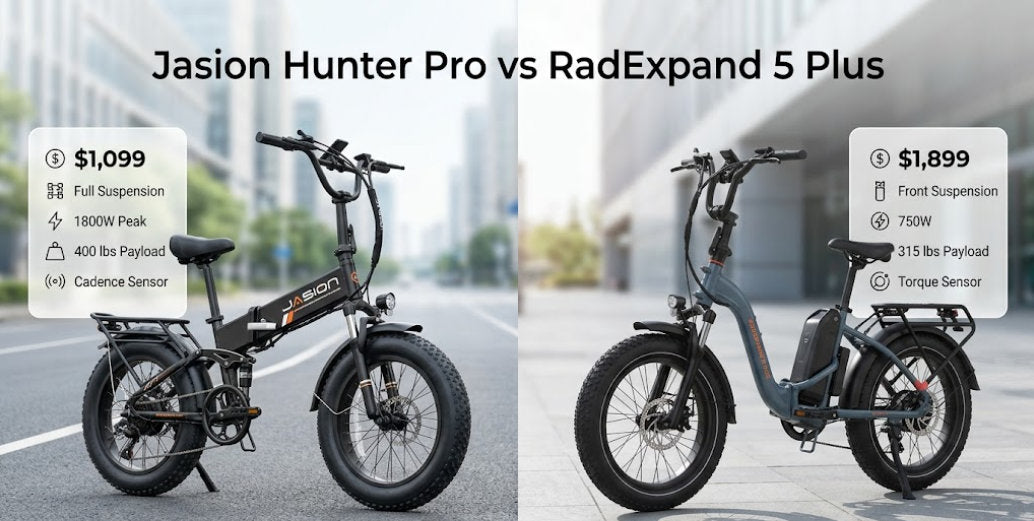
Its specs list dual hydraulic brakes, full suspension, a 1800W brushless hub motor, 95 Nm torque, 20 x 4'' fat tires, an 82 lb bike weight, and a 400 lb max payload.
That puts it in a category where braking control matters even more. Full suspension and fat tires can help with comfort and traction, but the brake system still needs to handle weight, speed, and uneven terrain.
For riders who expect rougher surfaces, hills, or more aggressive use, hydraulic disc brakes are a better match than basic mechanical brakes.
Thunder: Another All-Terrain Hydraulic Example
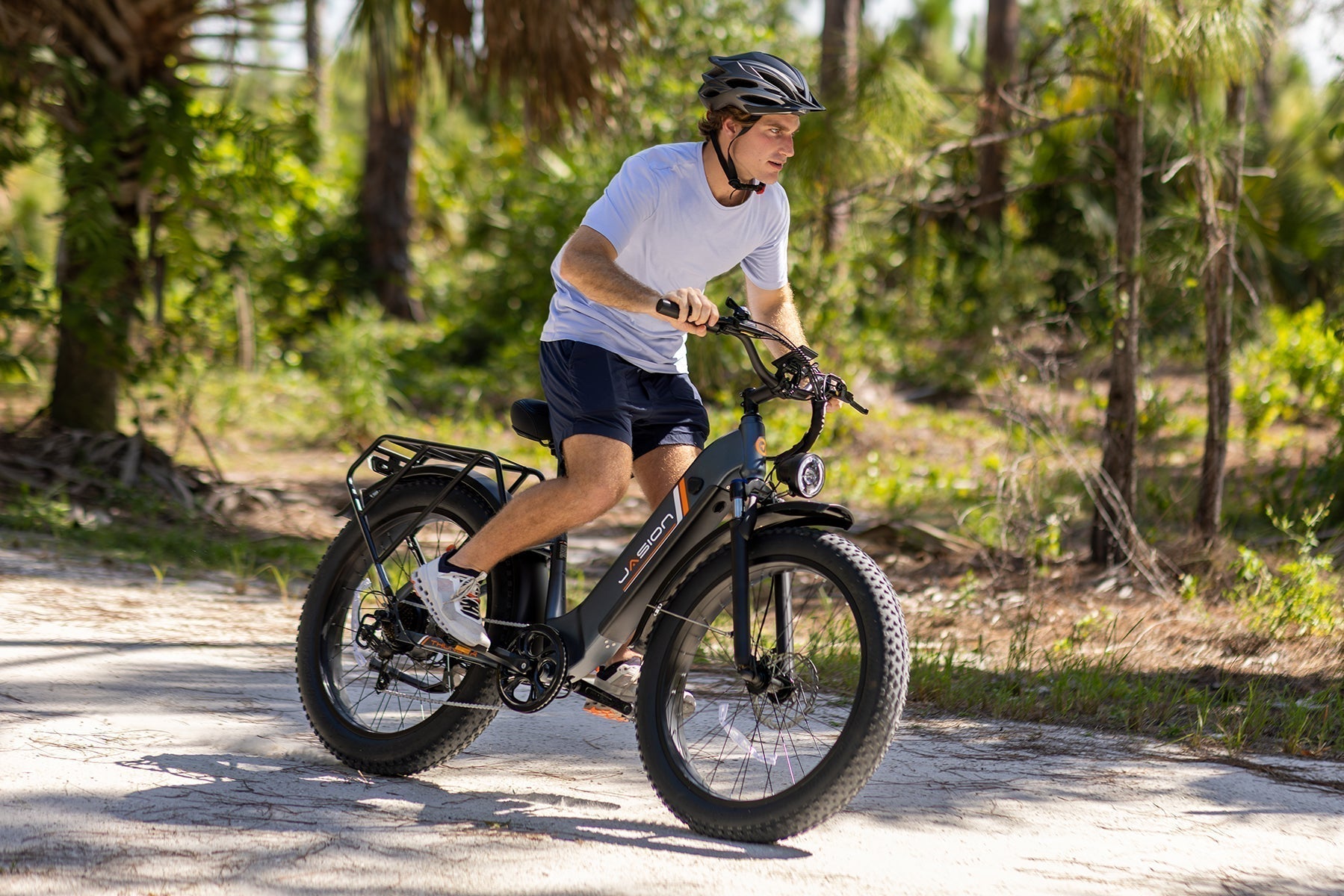
The Jasion Thunder also fits this discussion. It uses dual hydraulic brakes, a 1800W brushless hub motor, 26 x 4'' fat tires, an 82 lb bike weight, and a 400 lb max payload.
Because it uses larger fat tires and is built for all-terrain riding, hydraulic braking is relevant for the same reason: the bike needs braking control that matches its size, speed, and intended use
Maintenance: Cable Adjustment vs Brake Bleeding
Maintenance is where the hydraulic vs mechanical debate becomes practical.
Mechanical brakes are easier to understand, but they often need more frequent adjustment. Hydraulic brakes need less routine tuning, but bleeding is more technical.
Jasion’s e-bike troubleshooting guide covers common brake checks, including brake lever return, brake sensor connectors, brake icons, and brake-related error codes.
Mechanical Brake Maintenance Reality
Mechanical disc brakes depend on cable tension and pad position.
Common maintenance tasks include:
- tightening cable tension
- replacing worn brake pads
- cleaning or replacing dirty cable housing
- checking cable routing
- centering the caliper
- adjusting pad clearance
- fixing rubbing or squeaking
- checking lever travel
If the lever pulls too close to the handlebar, the cable may need adjustment or the pads may be worn.
If the brake feels heavy or does not return smoothly, the cable or housing may be dirty, corroded, kinked, or creating too much friction.
If the rotor rubs, the caliper may need to be re-centered.
A common starting point for rubbing brakes is to loosen the caliper mounting bolts slightly, squeeze the brake lever to help center the caliper over the rotor, then tighten the bolts again. This does not fix every case, but it is often the first adjustment to check.
Hydraulic Brake Maintenance Reality
Hydraulic brakes do not have a cable to stretch, so they usually need less frequent lever adjustment.
But they are not maintenance-free.
You still need to:
- inspect brake pads
- check for rubbing
- keep rotors clean
- avoid contaminating pads with oil
- check lever feel
- inspect hoses for damage or leaks
- bleed the system if the lever feels soft or spongy
A spongy lever can mean air has entered the hydraulic system or the brake needs service. Bleeding removes air from the system, but it requires the correct fluid, tools, and process.
If you are not comfortable working with hydraulic brakes, professional service is usually the safer choice.
Which Is Easier for Most Riders?
It depends on what kind of maintenance you prefer.
Mechanical brakes are easier to understand and easier to adjust at home, but they often need more frequent small adjustments.
Hydraulic brakes are more convenient day to day, but when they need bleeding or leak repair, the work is more technical.
A practical rule:
- Choose mechanical if you want lower cost and simple DIY service.
- Choose hydraulic if you want smoother braking and less frequent adjustment.
- Choose hydraulic for heavier e-bikes, hills, cargo, and frequent stop-and-go riding.
Why E-Bike Brakes Are Not Just Bicycle Brakes
On an e-bike, brakes may do more than slow the wheel.
Depending on the model, brake levers may also interact with the electrical system. They may trigger:
- motor cut-off
- brake lights
- controller signals
- throttle disable functions
- display warnings
- brake sensor errors
That is why brake troubleshooting on an e-bike can be different from brake troubleshooting on a regular bicycle.
If a brake lever is stuck or a brake sensor connector is loose, the bike may show a brake icon, an error code, or refuse to provide motor power.
This is also why brake upgrades should be done carefully. Replacing a brake lever or hydraulic system without considering motor cut-off sensors or wiring can create electrical issues, not just mechanical ones.
Can You Upgrade Mechanical Disc Brakes to Hydraulic?
In some cases, yes. But it is not always a simple bolt-on upgrade.
An e-bike brake upgrade may involve:
- compatible brake levers
- correct hose length
- caliper mount compatibility
- rotor compatibility
- internal or external routing
- motor cut-off sensor compatibility
- brake light signal compatibility
- correct brake fluid
- bleeding after installation
On a regular bicycle, the question may be mostly mechanical. On an e-bike, the brake lever may also communicate with the motor controller.
So the safest answer is:
Some e-bikes can be upgraded from mechanical disc brakes to hydraulic disc brakes, but compatibility matters. If you are not experienced with e-bike brake systems, ask the manufacturer or a bike shop first.
For many riders, it is better to choose the right brake system when buying the bike instead of planning an upgrade later.
Which One Should You Choose?
Choose hydraulic disc brakes if braking confidence matters more than the lowest possible cost.
Choose mechanical disc brakes if budget, simplicity, and DIY service matter more.
| Rider or situation | Better fit |
|---|---|
| Flat-road budget commuter | Mechanical can be enough |
| Lighter e-bike | Mechanical can be enough |
| Heavy e-bike | Hydraulic preferred |
| Fat tire e-bike | Hydraulic preferred |
| Hills or long descents | Hydraulic preferred |
| Frequent city traffic | Hydraulic preferred |
| Low hand strength | Hydraulic preferred |
| DIY roadside repair | Mechanical preferred |
| Remote touring | Mechanical may be easier |
| Cargo or high payload | Hydraulic preferred |
| Lowest upfront cost | Mechanical |
Choose Mechanical Disc Brakes If You Want:
- lower upfront cost
- easier basic service
- simple parts
- no brake fluid
- easier cable adjustment
- acceptable braking for flatter routes
Choose Hydraulic Disc Brakes If You Want:
- smoother lever feel
- stronger braking confidence
- less hand effort
- better modulation
- better control on hills
- better fit for heavier e-bikes
- less frequent cable-style adjustment
For most fat tire, all-terrain, high-payload, or faster e-bikes, hydraulic disc brakes are the better match.
For lower-speed, flatter, lighter, budget-focused riding, mechanical disc brakes can still be enough when properly adjusted.
FAQ
Are hydraulic disc brakes worth it on an e-bike?
For heavier, faster, hill-riding, or cargo e-bikes, hydraulic disc brakes are usually worth it. They give smoother control, stronger lever feel, and less hand effort. For light flat-road riding on a tighter budget, mechanical disc brakes can still work if properly adjusted.
Are mechanical disc brakes bad?
No. Mechanical disc brakes are not bad. They are simpler, cheaper, and easier to service. Their main downside is that they often need more frequent adjustment and can require more hand effort than hydraulic brakes.
Do hydraulic brakes need less maintenance?
Hydraulic brakes usually need less frequent adjustment than mechanical brakes, but they are not maintenance-free. Brake pads still wear, rotors still need to stay clean, and the system may need bleeding if the lever feels soft or spongy.
Why do mechanical disc brakes keep getting loose?
Mechanical disc brakes can feel loose because of cable stretch, pad wear, cable housing friction, or caliper alignment. As pads wear, the gap between the pad and rotor changes. As cables stretch, lever travel can become longer.
What does a spongy hydraulic brake lever mean?
A spongy hydraulic brake lever may mean there is air in the system, the brake needs bleeding, the pads are worn, or there is another hydraulic issue. If braking power drops or the lever feels soft, the system should be checked before riding.
Can I upgrade mechanical disc brakes to hydraulic brakes?
Sometimes. But e-bike compatibility matters. You may need compatible levers, hoses, calipers, routing, motor cut-off sensors, and brake light wiring. If you are not experienced with e-bike brake systems, ask the manufacturer or a bike shop first.
Which brake is better for heavy e-bikes?
Hydraulic disc brakes are usually better for heavy e-bikes because they need less hand effort and provide smoother control. Heavy bikes create more momentum, especially with cargo, hills, or higher speeds.
Do brake pads matter as much as brake type?
Yes. Brake pads affect noise, heat resistance, wet-weather performance, rotor wear, and braking feel. Resin pads are often quieter and smoother, while metallic pads usually handle heat and wet conditions better.
Are hydraulic brakes better in the rain?
Hydraulic brakes usually feel more consistent in wet conditions because they use a sealed system and offer better modulation. However, tire grip, brake pads, rotor condition, and riding speed also matter.
Should every e-bike have hydraulic disc brakes?
Not necessarily. A lighter, lower-speed, flat-road commuter can work with mechanical disc brakes if they are properly adjusted. But for heavier e-bikes, fat tire models, hills, cargo, or faster riding, hydraulic brakes are usually the better choice.
Conclusion
Choose mechanical disc brakes if the bike is lighter, the route is flat, the budget is tight, and you are comfortable with occasional cable and pad adjustment.
Choose hydraulic disc brakes if the bike is heavier, faster, used on hills, fitted with fat tires, carrying cargo, or ridden often in traffic or wet conditions.
For an e-bike, braking is not just about the brake label. It is about whether the full setup can handle the bike’s weight, speed, terrain, tires, payload, and your riding habits.
If you are buying a heavier all-terrain e-bike, hydraulic brakes are not just a premium feature. They are part of keeping the ride controlled, predictable, and easier to stop.


Share: