
 EU
EU
 UK
UK
 US
US
 CA
CA



A 20-mile commute and a full day of riding do not ask the same thing from an ebike battery.
For shorter, predictable trips, one battery may be all you need. But when the route gets longer—or includes hills, frequent throttle use, extra stops, and fewer places to plug in—a dual battery electric bike gives you more room to ride without watching the battery indicator all day.
The real question is not whether two batteries are better on paper. It is whether the extra capacity fits the way you actually ride.

Are Dual Battery Electric Bikes Worth It?
They can be, especially for riders who regularly cover longer distances or want to charge less often.
A dual battery setup makes the most sense when you want:
- More range for long commutes or full-day rides
- Fewer charging sessions during the week
- Extra battery reserve for hills and higher assist levels
- More flexibility for errands, detours, and changing plans
- Less need to plan every route around the next outlet
If your usual ride is short and charging is always convenient, a single battery can still be the simpler choice. But when your regular route starts using most of the available charge, a second battery becomes much more useful.
What Does a Dual Battery Setup Actually Change?
A dual battery ebike carries two batteries that supply energy to the same drivetrain. The batteries may be mounted in different parts of the frame or integrated into the bike as one complete system.
How the bike draws power from those batteries depends on its electrical design. Some systems use one battery and then the other, while others manage power between both automatically.
Either way, the benefit riders notice is the same: more total energy is available before the bike needs to be plugged in again.
If you want a closer look at voltage, amp-hours, watt-hours, charging, and battery care, the Jasion electric bike battery guide covers those fundamentals in more detail.
Do Two Batteries Double Your Range?
Not necessarily—but they can increase it substantially.
Battery capacity is only one part of range. Speed, rider weight, terrain, assist level, throttle use, wind, temperature, tire pressure, and frequent stops all affect how far an ebike travels.
The RetroVolt Pro and RetroVolt Max show how this works in practice:
| Specification | RetroVolt Pro | RetroVolt Max |
|---|---|---|
| Battery system | 52V 20Ah single battery | 52V 40Ah dual-battery system |
| Claimed maximum range | Up to 90 miles | Up to 150 miles |
| Bike weight | 82 lbs | 108 lbs |
The Max doubles the listed battery capacity, while claimed maximum range increases from 90 to 150 miles. That is a major increase, but not a simple doubling of distance.
The Max also carries the added battery hardware and a more substantial suspension setup. Once the bike is moving, the rider, route, speed, and riding mode determine how much of that extra capacity becomes usable range.
For a closer model-by-model breakdown, see the RetroVolt Pro vs RetroVolt Max comparison.

Where a Second Battery Makes the Biggest Difference
Long Commutes
A longer daily route is easier to manage when you are not relying on workplace charging. Extra capacity also leaves room for a grocery stop, a different route home, or an unexpected headwind.
Full-Day and Weekend Rides
Recreational rides rarely follow the exact plan. With more range in reserve, adding another stop or taking the scenic route becomes an option instead of a calculation.
Hills and Stronger Assist Levels
Climbing and higher assist settings ask more from the battery. A second battery does not create additional motor torque, but it gives the system more stored energy for demanding routes.
Frequent Throttle Use
Throttle riding generally uses energy faster than light pedal assistance. Riders who prefer stronger motor support are more likely to benefit from a larger battery reserve.
Several Trips Between Charges
You do not need to ride 100 miles in one day to appreciate two batteries. A larger system may simply let you complete several commutes, errands, or neighborhood rides before charging again.
Single Battery or Dual Battery: Which Fits Your Ride?
| A Single Battery May Fit You If... | A Dual Battery May Fit You If... |
|---|---|
| Your regular routes are relatively short | You frequently ride longer distances |
| You can charge easily at home or work | You have limited charging access during the day |
| Lower bike weight is a priority | Maximum range matters more than minimizing weight |
| You normally use low or moderate assist | You prefer stronger assist or frequent throttle use |
| Your routes are predictable | You want room for detours and changing plans |
| You usually return with plenty of charge remaining | You regularly finish rides with a low battery |
Neither setup is automatically better. The right one is the setup that gives you enough range without adding capacity you are unlikely to use.
What to Check Before Buying a Dual Battery Ebike
Look at Total Capacity, Not Just the Battery Count
“Dual battery” tells you how many battery packs the bike carries, but not how much total energy they store. Compare the full voltage and amp-hour specification before comparing range claims.
Check What the Range Figure Represents
Maximum range is usually measured under favorable conditions. Use it as a comparison point, then leave a practical buffer for your speed, route, weight, weather, and preferred assist level.
Consider the Whole Bike
Longer rides place more importance on comfort and control. Look at the suspension, tires, riding position, brakes, and motor torque—not just the battery.
Think About Storage and Handling
A second battery makes the bike more substantial. That may matter if you regularly lift the bike, carry it upstairs, or load it onto a rack. For riders with ground-level storage, the added capacity may be the more important consideration.
Choose a Factory-Integrated System
A purpose-built dual battery setup is designed around the bike’s frame, wiring, controller, and battery management system. That is different from improvising an extra battery onto a bike that was not designed for one.
Check Charging and Replacement Support
Review the model’s charging instructions and confirm that compatible chargers and replacement batteries are available. The best dual battery electric bike is not simply the one with the largest number—it is the one that fits your route and remains practical to own.
RetroVolt Max: A Dual Battery Moped Style Ebike
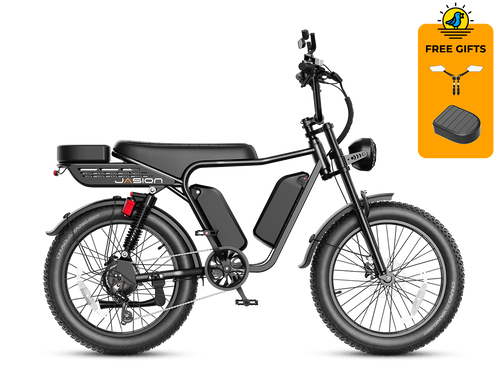
The Jasion RetroVolt Max pairs a 52V 40Ah dual-battery system with the comfort and road presence of a moped style ebike.
Its main specifications include:
- Up to 150 miles of claimed maximum range
- 2000W peak motor output
- 99 Nm of torque
- Upgraded front suspension fork
- Dual rear shock absorbers
- 2-piston hydraulic disc brakes
- 20" × 4.0" fat tires
The larger battery system is matched with suspension upgrades that make sense for longer rides. Rearview mirrors and a rear passenger seat cushion are also included, giving the bike a more complete setup from the start.
For a closer look at how those features come together on the bike, watch this RetroVolt Max review:
How to Make the Most of the Extra Range
Two batteries give you more capacity, but riding habits still determine how quickly that capacity is used.
- Use moderate pedal assistance when distance matters most
- Pedal during acceleration and on climbs
- Keep the tires at the recommended pressure
- Avoid repeated hard acceleration when it is not needed
- Keep the chain and drivetrain clean and properly adjusted
- Store and charge the batteries according to the model instructions
- Leave extra range in reserve for cold, windy, or hilly rides
The goal is not to squeeze every possible mile out of every charge. It is to arrive with enough battery left that the ride never feels uncertain.
Related Jasion Guides
- Compare the wider lineup in our moped style ebike buying guide.
- See how moped, folding, full-size, and other wide-tire models differ in our Jasion fat tire electric bike guide.
Frequently Asked Questions
What is a dual battery electric bike?
A dual battery electric bike uses two batteries to increase the total energy available to its drivetrain. The additional capacity can extend range and reduce how often the bike needs to be charged.
Do two batteries double an ebike’s range?
Not always. Two batteries can increase range substantially, but actual distance also depends on speed, terrain, rider weight, assist level, throttle use, weather, tire pressure, and the overall design of the bike.
How far can a dual battery electric bike go?
It depends on the total battery capacity and riding conditions. The RetroVolt Max uses a 52V 40Ah dual-battery system and has a claimed maximum range of up to 150 miles under favorable conditions.
Are dual battery ebikes heavier?
They are generally more substantial because of the additional battery and supporting hardware. For riders who prioritize longer range and fewer charging stops, the extra capacity may be more valuable than keeping the bike as light as possible.
Are dual battery electric bikes better for hills?
A second battery does not increase motor torque by itself, but it provides more stored energy for routes where the motor works harder. Hill performance also depends on motor output, torque, total weight, grade, and riding conditions.
Who should consider a dual battery ebike?
Dual battery ebikes are well suited to long-distance commuters, weekend riders, people with limited charging access, riders in hilly areas, and anyone who regularly uses higher assist levels or throttle support.
Is a 52V 40Ah battery system suitable for long rides?
Yes. A 52V 40Ah system provides substantial capacity for long-distance riding. On the RetroVolt Max, it supports a claimed maximum range of up to 150 miles under favorable conditions.
Give the Ride More Room
The value of two batteries is not limited to one exceptionally long trip. It can mean charging less during the week, leaving more room for unplanned stops, and starting a ride without wondering whether the return trip will be too far.


Share: