
 EU
EU
 UK
UK
 US
US
 CA
CA



A bike lane sign identifies space designated for bicycle travel. A yellow bicycle sign warns of bicycles entering or crossing the road, while a green bike route sign helps riders find their way. The pavement markings, arrows, and signals around each sign tell you how to follow the route.
Planning a commute on a Jasion electric bike? Check where your route switches between bike lanes, shared streets, and crossings. Here is how to recognize each one.

Common Bike Signs and What They Mean
| What you see | Meaning | What to do |
|---|---|---|
| White BIKE LANE sign | Identifies a designated bicycle lane | Follow lane arrows and watch for changes near intersections. |
| Yellow or fluorescent yellow-green diamond with a bicycle | Warns road users of bicycle activity or a crossing | Look for the crossing location, approaching traffic, and any stop or yield control. |
| Green BIKE ROUTE or bicycle destination sign | Provides route guidance | Follow its direction while checking whether the next segment is shared or separated. |
| BICYCLES MAY USE FULL LANE | Reminds road users that cyclists may occupy the travel lane | Ride predictably with traffic and allow room around parked cars. |
| Bicycle inside a red circle with a diagonal slash | Bicycles are prohibited | Choose a permitted route. |
| Bicycle symbol beneath two chevrons on the road | Shared lane marking, also called a sharrow | Expect to share the traffic lane with motor vehicles. |
You may also see the wording BICYCLES ALLOWED USE OF FULL LANE on a full-lane sign.
Bike Lane, Bike Route, and Bicycle Crossing Signs
Bike lane signs
Follow the lane’s bicycle symbols and direction arrows. Some separated facilities carry bikes in both directions, so check which side to enter.
At driveways and intersections, vehicles may cross a bike lane where permitted. Look ahead for turning vehicles and follow the signs and signals controlling your movement.
Bike route signs
A green bicycle route sign may show a route number, destination, distance, or arrow. The route can include both dedicated bicycle facilities and shared streets.
A bicycle boulevard is usually a low-speed street arranged to favor bicycle travel through measures such as traffic calming and convenient crossings. Local motor traffic may still be present.
Bicycle crossing signs
Below the yellow warning sign, an AHEAD plaque indicates a crossing farther along. A downward diagonal arrow identifies the crossing location. A combined bicycle-and-pedestrian symbol may appear where a shared-use path crosses a road.
The warning sign alone does not give a rider permission to enter traffic. Use the crossing’s signals, stop or yield signs, and applicable right-of-way rules.
How to Read Bike Lane Markings
Solid and dotted white lines
A solid white line commonly separates a bike lane from adjacent traffic. Dotted lines can guide riders through an intersection or a transition where traffic crosses the bicycle route. Read them together with the arrows and signs.
Follow bicycle arrows rather than assuming a lane continues beside the curb. The route may shift around a turn lane, parking area, or bus stop.
Buffered and protected bike lanes
A buffered bike lane has extra painted space between the riding lane and traffic or parked vehicles. The striped buffer creates separation; it is not an extra riding or passing lane.
A protected or separated bike lane uses features such as curbs, posts, or a parking lane to separate bicycle travel from moving traffic. Check the direction markings and crossing points, especially where drivers enter a driveway or turn across the bikeway.
Green pavement
Green pavement makes bicycle space more visible. It may run along a lane or appear only where bicycle and motor-vehicle paths cross. The color does not replace a traffic light, stop sign, yield sign, or direction arrow.
For wet commutes, leave room to brake smoothly and avoid abrupt steering on slick surfaces. Our guide to riding an ebike in the rain covers bike preparation and after-ride care.
Sharrows
The bicycle-and-chevron marking helps riders position themselves in shared traffic. On streets with parked cars, allow space for doors to open. Look behind and signal before changing position.
Bike Boxes and Bicycle Signals at Intersections
A bike box is a marked waiting area ahead of the motor-vehicle stop line at a signalized intersection. Where the layout permits, riders approach through the bicycle lane and wait in the box during the red phase. Keep the crosswalk clear and follow the signal that applies to your movement. When the light is already green, proceed through the designated lane rather than moving sideways into the box.
A separate two-stage turn box works differently: it provides a place to wait after crossing the first part of an intersection, before making the second crossing. Follow its arrows and the signal for each stage.
If a bicycle-specific signal controls your lane, follow it. A nearby bicycle detector marking can show where to position the bike so the signal system detects you. Use a provided button when instructed.
Can Ebikes Use a Signed Bike Lane?
Ebike access depends on state and local rules, the type of facility, and the bike’s classification and configuration. Check route rules when planning your ride and follow posted restrictions.
California’s Class I–IV bikeway descriptions classify paths and lanes. Class 1–3 ebike labels classify vehicles. A Class II bike lane therefore does not mean “Class 2 ebikes only.” Jasion’s ebike class guide explains the vehicle categories.
Choose a Bike for Your Daily Route
For everyday errands and commuting, the Jasion EB5 Roamer ST has a step-through frame for easier mounting. Compare the riding position and frame fit alongside the route you plan to take.
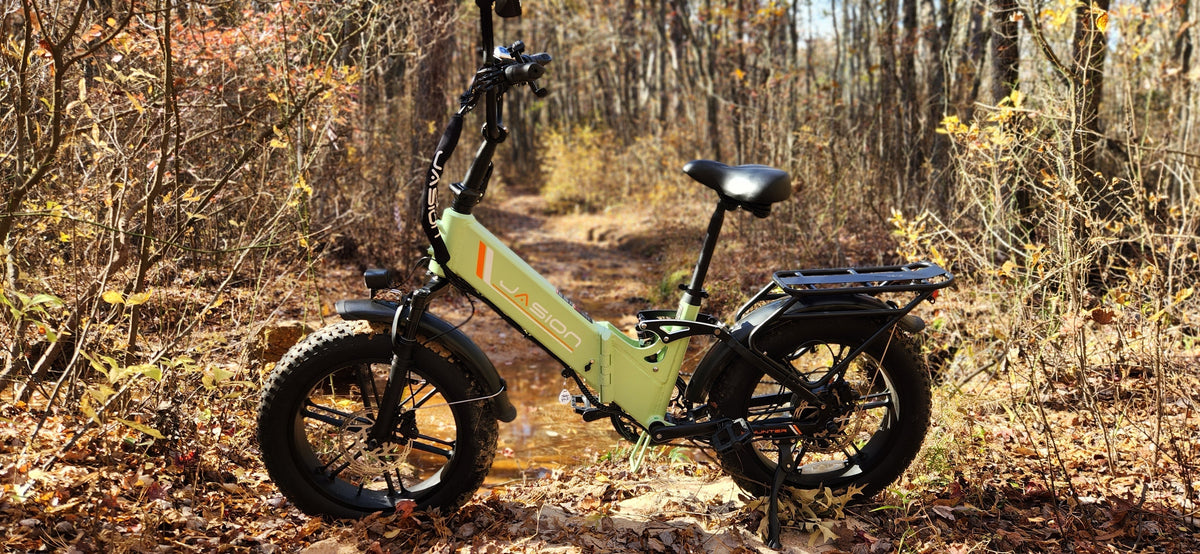
For a folding frame with fat tires, take a look at the Jasion X-Hunter ST. Check its folded dimensions against your storage space.
Our riding equipment guide covers lights and visibility. For parking at work or the shops, see how to lock an ebike.
Frequently Asked Questions
What does a yellow bicycle sign mean?
It warns road users of bicycle activity or a crossing. Read any accompanying arrow or AHEAD plaque to locate the crossing, then follow its signals and right-of-way rules.
Does a green bike route sign mean bikes only?
No. A green bike route sign provides directions along a bicycle route, which may include streets shared with motor vehicles.
What does a bicycle with two arrows on the road mean?
A bicycle beneath two chevrons is a sharrow. It marks shared-lane riding position and direction rather than a separate bicycle lane.
Does green pavement give cyclists automatic right of way?
No. Green pavement highlights bicycle space. Traffic signals, signs, and applicable right-of-way rules still control who proceeds.
Is a Class II bike lane only for Class 2 ebikes?
No. Bikeway classifications describe infrastructure, while ebike classes describe vehicles. Check the applicable access rules rather than matching the numbers.
For the national sign and marking reference, see the FHWA Manual on Uniform Traffic Control Devices. For your next ride, explore Jasion electric bikes and compare the features that suit your route.













Share: