
 EU
EU
 UK
UK
 US
US
 CA
CA



A 2000W ebike is often advertised in the 35 to 45 mph range, but 2000 watts cannot be converted into one guaranteed top speed. The result depends on whether 2000W means peak or continuous power, along with battery voltage, controller limits, motor design, wheel and tire size, total load, terrain, wind, and the bike's programmed speed settings.
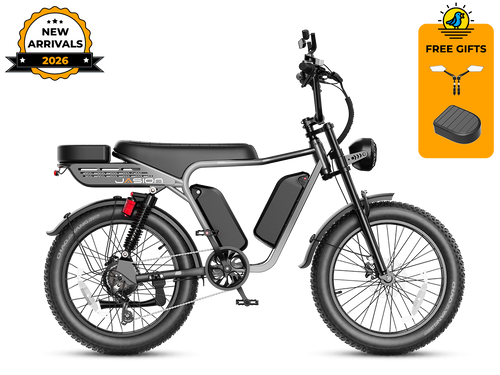
Current Jasion models show why the answer needs context. The RetroVolt Pro and RetroVolt Max both list 2000W peak power, 52V systems, and 99 N·m of torque. Their product pages list different maximum speeds: up to 38 mph for the RetroVolt Pro and 35+ mph for the RetroVolt Max. The wattage is the same, but the complete setups and intended uses are not.
How Fast Does a 2000W Ebike Go?
A reasonable general estimate is about 35 to 45 mph for an unlocked, performance-oriented 2000W ebike under favorable conditions. That is a market-wide estimate, not a promise that every 2000W model will reach every speed in that range. The manufacturer's speed specification for the exact bike is more useful than a generic watt-to-mph chart.
| Question | Practical answer |
|---|---|
| How fast is a 2000W ebike? | Many performance models are advertised around 35–45 mph, but check the exact bike's listed speed. |
| How fast is a 48V 2000W ebike? | Voltage and wattage alone are not enough to calculate mph. The controller, motor winding, wheel size, load, and speed settings are also required. |
| How fast are Jasion's 2000W models? | RetroVolt Pro lists up to 38 mph; RetroVolt Max lists 35+ mph on their current product pages. |
Actual riding speed can be lower than the listed maximum. A heavier load, lower battery state, uphill grade, headwind, loose surface, low tire pressure, or cold conditions can all affect performance. Maximum speed is also different from a comfortable cruising speed.
Why 2000W Does Not Equal One MPH Number
Watts describe power, while miles per hour describe speed. Power helps a bike accelerate and work against drag, rolling resistance, gravity, and load. It does not specify how the electrical system and drivetrain turn that power into road speed.
At higher speed, aerodynamic drag becomes increasingly important. Maintaining a few additional mph can demand much more power than the same increase at a low speed. That is one reason a simple statement such as “twice the watts means twice the speed” does not work.
Peak power versus rated power
Before comparing two bikes, look at the word next to the wattage. Peak power describes the motor system's maximum short-duration output under specified conditions. Rated or nominal power is a different measurement convention, generally associated with sustained operation.
A 2000W peak figure and a 2000W rated figure are not interchangeable. If one brand publishes peak power and another publishes rated power, comparing only the large number can create a false impression. Jasion describes the RetroVolt Pro and RetroVolt Max as 2000W peak models.
Battery voltage and controller output
Battery voltage influences the motor system's operating potential, but it still does not answer the speed question by itself. The controller determines how electrical power is delivered, and the motor must be designed to use that supply. A 48V 2000W setup can therefore have a different top speed from another 48V 2000W setup.
This also explains why “How fast is 48V 2000W in mph?” has no universal numerical answer. You would need the motor's characteristics, controller limits, wheel diameter, gearing or hub configuration, programmed speed limit, and test conditions. Moving from 48V to 52V does not automatically add a fixed number of mph.
Motor design and wheel size
Two motors can share the same power label but use different internal designs and tuning. One may prioritize quicker acceleration or pulling force, while another may be configured differently at higher wheel speed. A hub motor's wheel diameter also affects the relationship between motor rotation and ground speed.
Tires change the result too. Width, tread, construction, and pressure influence rolling resistance and traction. A fat-tire ebike built for mixed surfaces has a different job from a narrow-tire road-oriented machine, even if both display the same wattage.
Rider, cargo, terrain, and weather
More total weight generally affects acceleration and climbing more noticeably than maximum speed on level ground, but it still changes the work required from the system. Hills add gravity, loose terrain adds rolling resistance, and a headwind raises aerodynamic demand. Battery charge and temperature can also affect available output.
When comparing a video or owner report with a product-page specification, check whether the rider, surface, wind, battery state, tire pressure, and bike configuration were disclosed. A display reading from one short run is not automatically a repeatable speed for every owner.

2000W Ebike Speed: Jasion RetroVolt Pro vs. RetroVolt Max
Jasion's two current 2000W models make a useful comparison because they share several headline specifications while serving different priorities.
| Specification | RetroVolt Pro | RetroVolt Max |
|---|---|---|
| Listed motor power | 2000W peak | 2000W peak |
| Listed maximum speed | Up to 38 mph | 35+ mph |
| Battery system | 52V 20Ah | Dual 52V 20Ah batteries |
| Listed torque | 99 N·m | 99 N·m |
| Listed bike weight | 82 lb | 108 lb |
| Best reason to choose it | Performance-oriented moped style without the weight of a dual-battery setup | A much larger listed battery capacity for riders who prioritize range |
Specifications checked against the Jasion US product pages on September 20, 2026. Listed maximum speed and range are estimates, not guaranteed results. Product specifications may change; confirm the current page before ordering.
RetroVolt Pro: the lighter 2000W option
The Jasion RetroVolt Pro moped-style ebike pairs a 2000W peak motor with a 52V 20Ah battery. Its current page lists up to 38 mph, 99 N·m of torque, and an 82 lb bike weight. It is the more direct choice when the buyer wants the 2000W RetroVolt format without carrying the second battery and additional weight of the Max.

RetroVolt Max: dual batteries for longer-route priorities
The Jasion RetroVolt Max dual-battery ebike also lists a 2000W peak motor and 99 N·m of torque, but its defining difference is the dual 52V 20Ah battery system. The current product page lists 35+ mph and a 108 lb bike weight.
The extra battery capacity does not mean the Max must be faster. It is there to support a larger energy reserve. Choose it when the intended rides justify that capacity and you are comfortable managing the additional weight. For a closer feature comparison, read RetroVolt Pro vs. RetroVolt Max.

Is a 2000W Ebike Faster Than a 750W Ebike?
A 2000W system has more available power than a comparable 750W system, but that does not establish a fixed speed difference. The 750W bike may be programmed around a legal class limit, while the 2000W model may be designed for performance use. Their voltage, controller, motor type, wheel size, weight, and gearing may also differ.
For context on the lower-power query, see our guide to 750W electric bike top speed. When shopping, compare complete bikes rather than treating watts as the only performance measure. Jasion's ebike torque guide explains what the Nm figure adds to the picture.
Is a 2000W Ebike Right for You?
A 2000W model makes the most sense when its complete design fits your route and ownership needs. The larger number should solve a real problem, not simply win a specification comparison.
- Consider it for performance-oriented riding: Faster acceleration, hills, mixed surfaces, and a heavier bike can make additional available power relevant.
- Check the battery plan: High-speed riding can consume energy quickly. Compare battery capacity and realistic route needs, not only the maximum range claim.
- Check the bike's weight: Motor assistance does not help while lifting the bike into a vehicle or moving it up stairs.
- Choose appropriate brakes, tires, and suspension: Speed is only useful when the complete chassis suits the surface and the rider can control it.
- Confirm fit: Reach, seat position, rider-height guidance, and the ability to support the bike at a stop still matter on a powerful model.
If your riding is mostly short, flat neighborhood trips, you may not need this power level. If you want a moped-style format for longer or more demanding rides, the RetroVolt models give you two battery and weight profiles to compare. You can also browse the full Jasion electric bike lineup before deciding.
Can You Ride a 2000W Ebike on Public Roads?
Do not assume that a product called an ebike automatically fits the legal ebike definition everywhere you ride. In the United States, state and local rules commonly use motor power, assisted speed, throttle operation, equipment, and riding location to determine how a vehicle is classified and where it may be used. A 2000W bike can fall outside the familiar Class 1, Class 2, and Class 3 definitions in many jurisdictions.
This does not make the bike unusable; it means the intended location matters. Before riding on a street, bike lane, sidewalk, shared path, trail, or public land, check the rules for that exact location and the bike's current configuration. Private-property and off-road access also depend on the property owner's or land manager's rules. Follow the product manual and use suitable protective equipment for the riding environment.
For an explanation of the familiar three-class framework, read Class 1 vs. Class 2 vs. Class 3 ebikes. It is a starting point rather than a substitute for current local requirements.
How to Compare Speed Claims Before Buying
- Identify the power convention. Confirm whether the wattage is peak, rated, or nominal.
- Use the exact product-page speed. Do not replace it with a generic wattage chart.
- Check battery voltage and controller information. Voltage alone does not calculate mph, but the complete electrical system matters.
- Compare like-for-like conditions. Note rider load, surface, wind, grade, battery state, tires, and whether the number came from GPS or the bike display.
- Separate top speed from useful speed. Consider the pace you can comfortably control and sustain on your normal route.
- Resolve access before purchase. Confirm where the exact bike can be operated under current local rules.
The short answer is that a 2000W ebike may be capable of roughly 35 to 45 mph, but the exact model specification is the better answer. Within Jasion's current lineup, the RetroVolt Pro is listed at up to 38 mph, while the dual-battery RetroVolt Max is listed at 35+ mph. Their shared wattage does not make them identical bikes—and that is precisely why speed should be evaluated as part of the complete system.
Frequently Asked Questions
How fast is a 2000W ebike in mph?
Many performance-oriented 2000W ebikes are advertised at approximately 35 to 45 mph. That is a general market range, not a guaranteed conversion. Check whether 2000W is peak or rated power and use the exact model's listed maximum speed.
How fast is a 48V 2000W ebike?
There is no universal mph figure for a 48V 2000W ebike. Top speed also depends on the controller, motor design, wheel diameter, speed programming, load, terrain, battery state, wind, and test conditions.
Is a 52V 2000W ebike faster than a 48V 2000W ebike?
Not necessarily. Voltage affects the electrical system, but the controller, motor, wheel size, speed limits, and complete bike design determine how that system performs. A 52V label does not add a fixed number of mph.
How fast are Jasion's 2000W ebikes?
The current Jasion US pages list the 2000W peak RetroVolt Pro at up to 38 mph and the 2000W peak RetroVolt Max at 35+ mph. Actual speed varies with conditions, load, battery state, settings, and applicable limits.
Is a 2000W ebike street legal?
It depends on the jurisdiction, the bike's assisted speed and operating configuration, and where it is ridden. A 2000W model can fall outside common Class 1, 2, and 3 definitions. Check current state and local rules for the exact road, path, trail, or property before riding.




Share: