
 EU
EU
 UK
UK
 US
US
 CA
CA



A moped style ebike and an electric moped can look almost identical. Both may have a long seat, wide tires, a large headlight, and a motorcycle inspired frame. Their legal status and everyday use, however, can be very different.
A moped style ebike is built as an electric bicycle with moped inspired styling. An electric moped is generally a motor driven road vehicle powered by a battery. That difference can affect licensing, registration, insurance, and where the vehicle may be ridden.

The name or appearance alone does not determine the vehicle class. Motor output, assisted speed, throttle operation, equipment, and local law all matter.
Moped Style Ebike vs Electric Moped at a Glance
| Feature | Moped Style Ebike | Electric Moped |
|---|---|---|
| Basic design | Electric bicycle with moped or motorcycle inspired styling | Motor driven vehicle powered by electricity |
| Pedals | Usually has operable pedals | May or may not have pedals |
| Power delivery | Pedal assist, throttle, or both | Usually throttle controlled |
| Legal category | May qualify as an ebike when it meets applicable requirements | Commonly regulated as a moped, motorized bicycle, or another motor vehicle type |
| License and registration | Often not required for a qualifying ebike, although rules vary | More likely to require a license, registration, plate, or insurance |
| Typical riding access | Roads and some bike facilities where its class is permitted | Public roads where that vehicle class is allowed |
| Best fit | Riders who want bicycle functions with a moto inspired ride | Riders who want a road focused, motor driven vehicle |
This is a general comparison, not a legal classification chart. Check the rules for the vehicle and location before riding.
What Is a Moped Style Ebike?
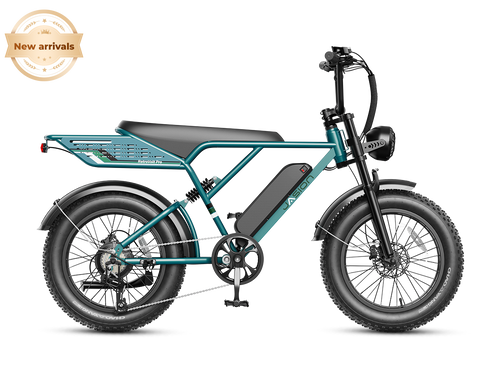
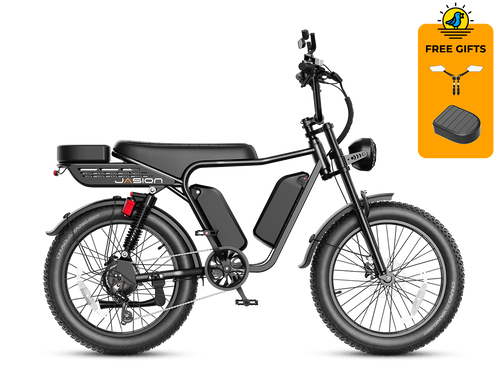
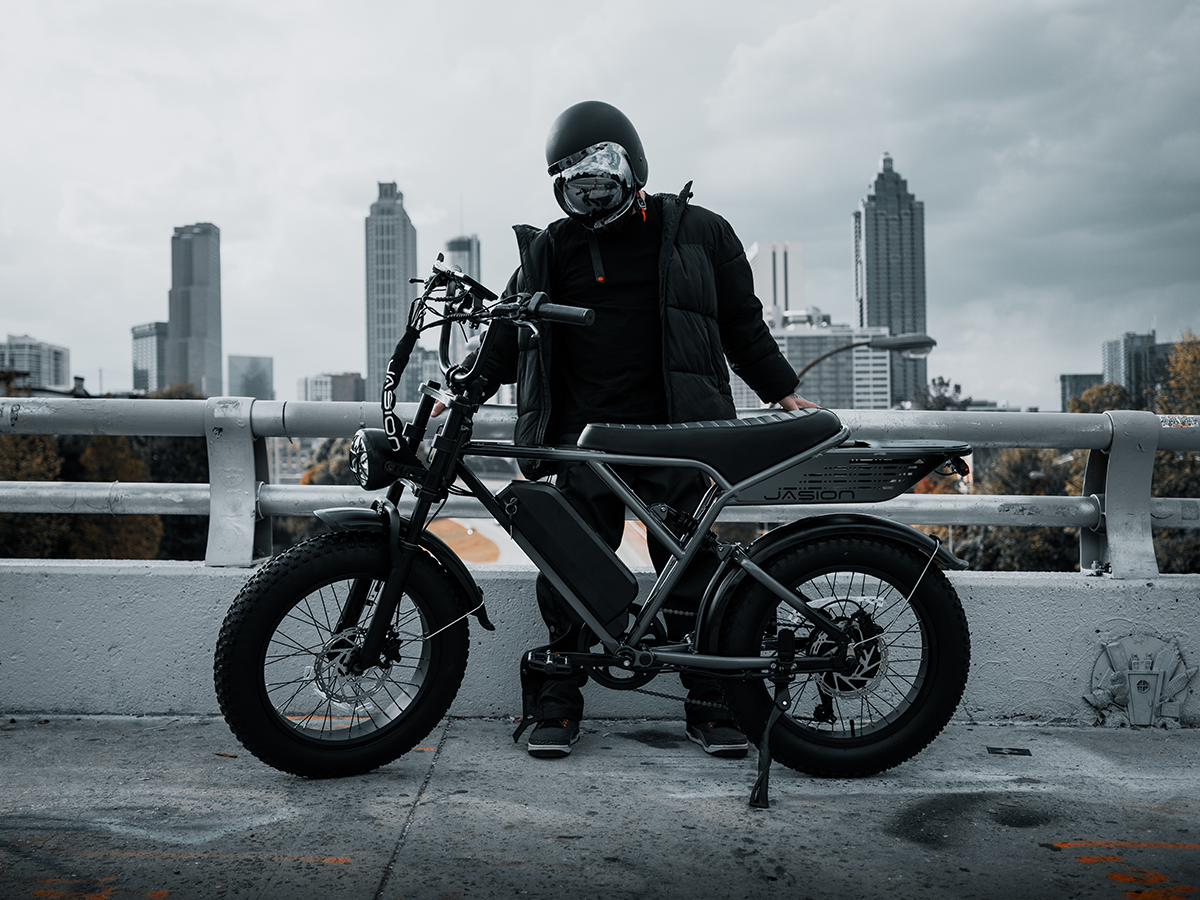
A moped style ebike is an electric bicycle with design cues borrowed from mopeds, minibikes, and motorcycles. Common features include a bench style seat, fat tires, a lower riding position, a large headlight, and front or full suspension.
The word “style” describes the look and riding format. It does not create a legal category.
These bikes appeal to riders who prefer a wider seat, a planted feel, and stronger electric support than a lightweight commuter bike typically provides. They can suit commuting, errands, and recreational riding when the model and route comply with local rules.
Jasion’s moped style ebikes include several battery and performance configurations for different riding needs.
What Is an Electric Moped?
An electric moped is a moped or similar motor driven cycle that uses an electric motor and battery instead of a gasoline engine. It is normally designed around throttle powered travel rather than active pedaling.
Unlike “moped style,” the term “moped” may refer to a vehicle category defined by state law. A state may consider maximum speed, motor output, number of wheels, pedals, transmission type, and required equipment.
Not every moped is pedal free. California, for example, notes that some mopeds have pedals that can be used when the motor is off. The state also requires an appropriate motorcycle license and special registration for qualifying mopeds. Those requirements are specific to California; other states use different definitions. See the California DMV moped guidance for that state’s current rules.
Appearance Does Not Decide the Legal Class
A long seat, fat tires, pedals, or a motorcycle style frame cannot establish whether a vehicle is an ebike. Two similar looking vehicles may fall into different categories because their assisted speeds, motors, controls, or operating modes differ.
Many states use a three class ebike system:
- Class 1: Assistance works while the rider pedals and stops at 20 mph.
- Class 2: A throttle can propel the bike, but assistance stops at 20 mph.
- Class 3: Assistance works while the rider pedals and stops at 28 mph.
This system is common, not universal. State definitions and local access rules can differ. The National Conference of State Legislatures maintains an overview of state ebike laws and classification systems.
Check the vehicle in its actual operating configuration. A setting that changes motor assistance or throttle speed may also affect where the vehicle fits under local law.
Pedals and Riding Experience
A moped style ebike usually gives the rider three options: pedal without assistance, use pedal assist, or use a throttle where the model and law allow it. Pedaling can reduce battery use and provide some physical activity.
The riding position is not the same as a conventional bicycle. Moped style ebikes are usually heavier, and a fixed bench seat may provide less leg extension than an adjustable bicycle saddle. Riders who plan to pedal for long periods should check seat height, reach, and pedal position carefully.
An electric moped is built for motor powered travel. Its weight, controls, seating, and road handling are closer to a small motor vehicle than a bicycle.
Speed and Power
State ebike class systems commonly use assisted speed thresholds of 20 or 28 mph. Electric mopeds follow separate state definitions and limits.
Do not compare vehicles by advertised top speed alone. Check:
- The speed at which pedal assistance stops
- The speed at which throttle assistance stops
- The available operating modes
- Whether any mode is intended only for private property or off road use
- Whether changing a setting affects the vehicle’s classification
Peak motor output also does not predict the entire riding experience. Battery voltage, controller programming, rider weight, grade, temperature, and tire pressure affect acceleration and climbing performance.
Where Can You Ride?
A qualifying ebike may be allowed on roads and certain bicycle facilities, but access often depends on its class and the rules set by the state, city, or facility manager. A trail that permits Class 1 ebikes may restrict Class 3 models.
Electric mopeds are generally road vehicles. Bike lanes, shared paths, sidewalks, and recreational trails may be off limits even when the vehicle has pedals.
Before riding, confirm:
- The vehicle definition used by your state
- City or county restrictions
- Rules for the specific road, path, park, or trail
- Age and helmet requirements
- License, registration, plate, and insurance requirements
Range and Charging
Both vehicle types may use rechargeable lithium ion batteries. Range depends on total battery energy, speed, terrain, temperature, tire pressure, rider weight, cargo, and riding mode.
A moped style ebike can use pedal assist to conserve energy. Sustained throttle use and higher road speeds normally consume more power.
When comparing range claims, look for battery capacity in watt hours and the conditions used for the estimate. A documented route test is more useful than a maximum figure without rider weight, speed, elevation, and temperature.
For more detail on battery capacity and riding conditions, read the dual battery electric bike guide.
Cost, Maintenance, and Storage
A qualifying ebike may avoid vehicle registration and insurance costs, depending on local law. Routine service can include tires, brake pads, chains, gears, spokes, suspension, and battery care.
An electric moped may add licensing, registration, plates, insurance, inspections, or vehicle specific service. Confirm that local shops can maintain the model before buying it.
Both types can be heavy. Measure doors, elevators, storage areas, and vehicle racks before ordering. A bike that fits the route but not the available storage can quickly become inconvenient.
Which One Should You Choose?
A moped style ebike is likely the better fit if you want:
- Pedal assist with optional throttle support
- Access to permitted bicycle infrastructure
- Bicycle style maintenance and ownership
- A comfortable, moto inspired design for local trips
An electric moped may fit better if you want:
- A throttle driven road vehicle
- Little or no pedaling
- A vehicle style seating and control layout
- Road use and are prepared for applicable motor vehicle requirements
Start with the route and local law, then compare fit, range, storage, service, and total ownership cost.
Where the RetroVolt Max Fits
The RetroVolt Max combines a moped inspired frame with operable pedals, pedal assist, throttle support, a 52V 40Ah dual battery system, fat tires, and front and rear suspension.
Its appearance does not decide where it may be ridden. Review the current operating modes and the rules for your route before use.
To compare it with the lighter single battery model, see RetroVolt Pro vs RetroVolt Max. You can also compare the full lineup in the moped style ebike buying guide.
Frequently Asked Questions
Is a moped style ebike the same as an electric moped?
No. “Moped style” describes the design of an ebike. An electric moped may be classified as a motor vehicle with separate licensing, registration, equipment, and riding rules.
Does a moped style ebike need a license?
It depends on whether the vehicle qualifies as an ebike under state and local law. Many qualifying ebikes do not require a driver’s license, but a vehicle that falls outside an applicable ebike definition may face different requirements.
Can a moped style ebike use bike lanes?
Access depends on the vehicle’s class and the rules for that location. Some jurisdictions or facility managers restrict higher class ebikes or throttle equipped vehicles.
Do electric mopeds have pedals?
Some do and some do not. Pedals alone do not determine whether the vehicle is an ebike or a moped.
Is a moped style ebike good for commuting?
It can be a practical commuter if its legal access, range, riding position, storage needs, charging options, and weight fit the route.


Share: